
Coaching with and in conflict (part 1 of 3)
“What’s going on when our coachees are in conflict?”
A coachee arrived for a session recently and I noticed it before she’d even sat down. A sigh on the way into the room. A slight gritting of the teeth as she settled into her chair. Nothing was said, but something had clearly happened just before we started.
That small moment stayed with me. Not because it was dramatic, but because of how much information was contained in it. Her body had already told me she was carrying something, and it shaped how I was for the rest of that session: a little more curious and aware of my own bias towards holding frustration and anger.
As coaches, conflict shows up in our rooms all the time, even when it’s never named as such. A coachee who is quietly furious with a colleague. A coachee bracing for a conversation they’ve been avoiding for weeks. A coachee replaying an argument from that morning’s stand-up. Helping them work with or in conflict, rather than simply around it, means understanding a bit more about what’s actually going on for them.
This is the first of three short pieces on coaching with/in conflict. This covers what may be going on for our coachees when they are experiencing conflict.
Our brain: what’s happening
When we experience conflict, our brain can perceive it as a threat. Psychology Today put it well in 2025: conflict activates the brain’s salience system, making it harder to think clearly. The brain’s salience system acts a neural traffic controller, sifting through internal and external stimuli to detect what matters most and switching attention between inward and outward states. In practice, this means the “thinking brain” (our rational, cognitive brain) can be overshadowed by the limbic system and, in more extreme moments, the more primitive reptilian responses that together Bessel van der Kolk refers to as the “emotional brain.”
This matters in our coaching. A coachee who is mid-threat-response is not being difficult, evasive or irrational. Their physiology has simply prioritised survival over reflection. Our first job, before turning to any model or tool, is often to help create enough safety and regulation that the thinking brain can come back online. In practice, this can involve us focussing on the relational container and doing what we can to let our coachees feel seen, heard and felt.
The values and beliefs beneath the reaction
Conflict can look like a disagreement about facts. Underneath, it can be a collision of values and beliefs.
Take a simple, common scenario. A manager says to a team member: “I’d like to give you some feedback on your presentation.” That’s the external event — the same six words, heard by two different nervous systems.
The manager, whose values might include directness, excellence and accountability, and who believes feedback helps people grow, interprets this as helpful coaching. The team member, whose values might include harmony, respect and self-growth, and who believes criticism means they are failing, interprets the exact same sentence as an attack.
Neither person has misheard. They have each filtered an identical event through a different internal lens, and arrived somewhere entirely different. Conflict often isn’t a dispute about what happened; it’s a collision between two sets of implicit, rarely-examined assumptions about what’s important or appropriate. That’s what makes it so hard to resolve — each party tends to assume their own interpretation is simply, self-evidently, correct.
As coaches, recognising that conflict is often rooted in differing values rather than incompatible personalities changes what we’re able to do with it. When we help a coachee identify the beliefs underpinning their own reaction, and get curious about what might be underpinning someone else’s, we open the door to self-awareness, empathy and cognitive flexibility — the ingredients of a more respectful, more productive conversation.
Where transactional analysis may shed some light
A lens I find useful is Transactional Analysis (TA), which looks at the “ego state” — Parent, Adult or Child — that someone is communicating from.
I’ve watched a “Parent-to-Parent” conflict play out in a leadership meeting, two senior figures each certain of what “should” be done, neither willing to yield, until the CFO left the room in tears. I’ve also sat with the aftermath of a “Child-to-Child” conflict — five people in a leadership meeting, emotion running the show, nobody taking ownership, everybody blaming everybody else, and real damage done to the team as a result.
TA gives us language for both. In Parent–Parent interactions people can become entrenched in competing views of what “should” happen. In Parent–Child interactions, one person criticises or directs while the other responds with compliance, withdrawal or rebellion. In Child–Child interactions, emotion dominates and reactivity takes over from thoughtful dialogue.
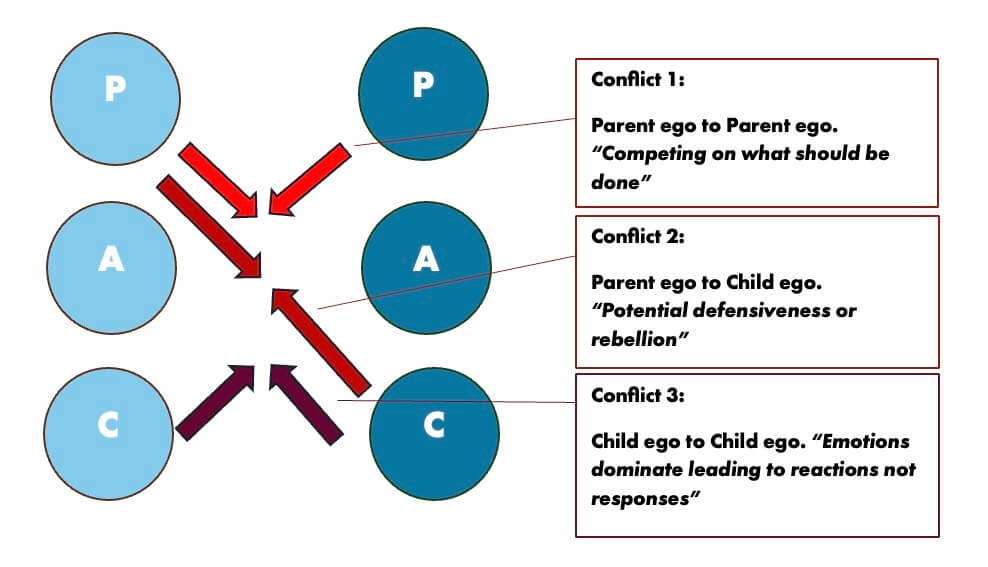
Our role, using this lens, is to help a coachee notice which ego state they’re responding from, and gently explore the assumptions or emotions driving it. From there, we can help them shift towards the Adult ego state — the place from which curiosity, evidence and present-moment awareness are possible.
So, what is our role as coaches?
Bring these lenses together and a pattern emerges. Our job is not to resolve the conflict for our coachee, or even to tell them which model applies. It’s to help them notice what’s happening — in their brain, in their beliefs, in the ego state they’ve dropped into — so they have a genuine choice about how to respond, rather than simply reacting.
That means encouraging a specific set of skills and capabilities in our coachees: curiosity, self-awareness, emotional regulation, reflective listening, perspective-taking, and assertive communication. All of it in service of one shift — helping them respond, rather than react, to the conflict they’re experiencing.
Understanding why conflict grips us the way it does is the first half of the picture. In the next post, I’ll share a practical model — the Smart Conflict 5R framework — that gives us, and our coachees, something else that may choose to do in conflict.
Something to sit with: next time you notice a coachee sigh, or grit their teeth, on the way into the room — what might be true for them, beneath the surface, before they’ve said a word?
Get free coaching and mindfulness resources
Join our community for free and get a host of essential resources, including an e-book on becoming a professional coach, access to our coaching webinars, a mindfulness e-kit and much more.